
Commercial Ice Machine Repair
Continue from the symptom guide to the relevant commercial service or related diagnostic topic.
View commercial ice machine repair →An empty ice bin during service is a solvable problem, and often a fast one. This guide walks commercial operators through the checks you can safely run yourself, the faults that need a technician, and how to tell tonight's emergency from this week's appointment. Written by the commercial refrigeration team at Elite Service & Enterprises, Chesapeake, Virginia.
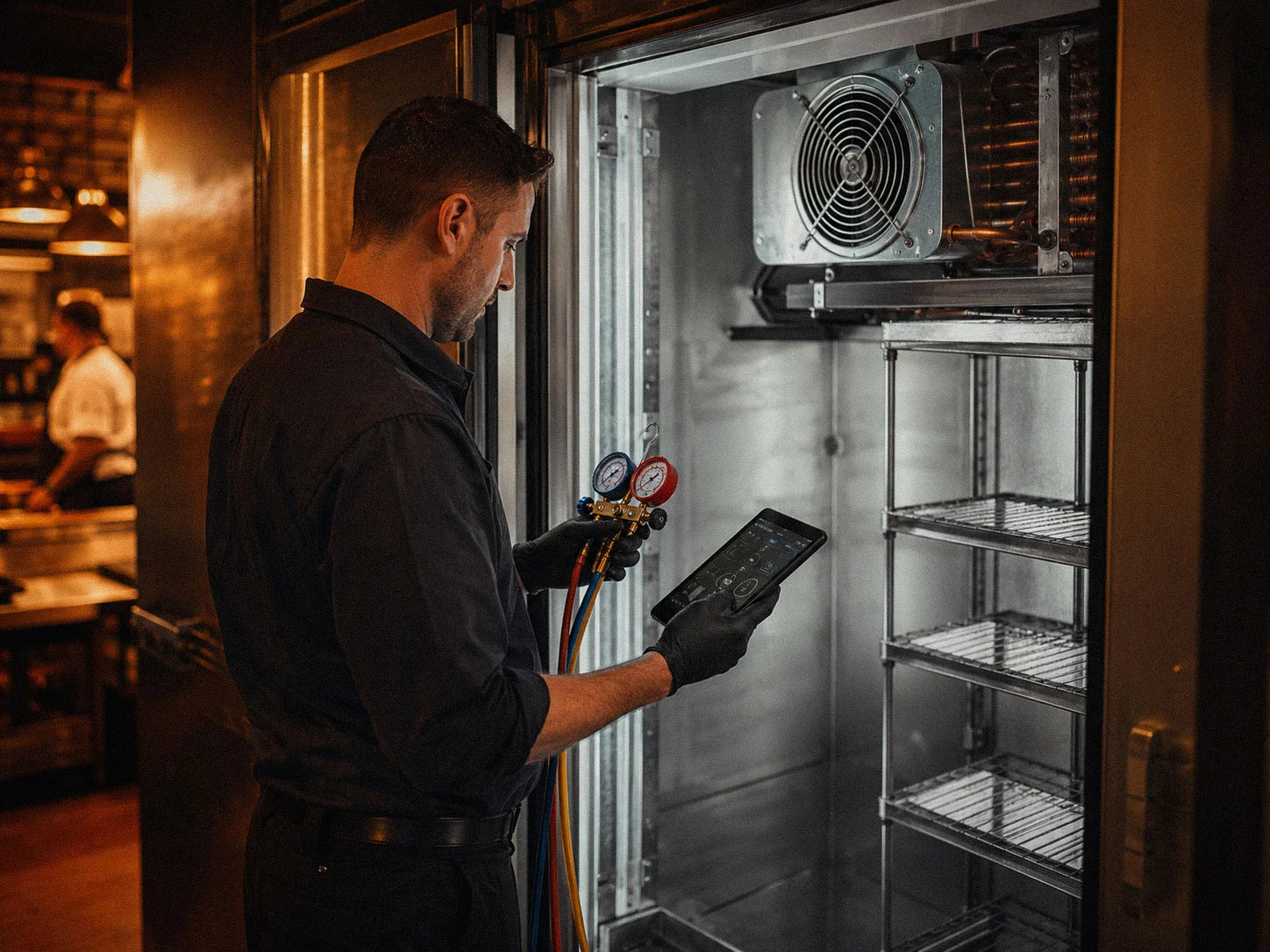
An ice machine that stops producing rarely announces why. The lights stay on, the compressor may still hum, and the bin just gets emptier every hour of service. The good news: a meaningful share of no-ice calls trace back to conditions an operator can find in ten minutes, and the rest can at least be triaged so you know whether you are calling tonight or scheduling this week.
One rule before anything else: check with your eyes and hands on the outside of the machine. Do not remove panels, do not touch refrigerant lines, and do not keep power-cycling a machine that faults right back. Those moves turn repairable problems into expensive ones.
Usually a harvest problem: a failed harvest sensor, a stuck water dump valve, or scale bonding the ice slab to the evaporator plate. Scale is the quiet one. It builds until harvest fails intermittently, then constantly. This is a technician repair, and if scale is the cause, the fix includes the descaling and the water treatment conversation that prevents round two.
Low refrigerant charge from a leak, a failing compressor, or a hot water supply. Charge problems are licensed-professional territory: the leak is the repair, and topping off without fixing it just rents you the same failure again.
Control board, transformer, or a safety lockout doing its job. Note any code, leave it off, and call. Repeated restarts against a lockout are how small failures recruit bigger ones.
That is a water and sanitation problem, not a production problem: scale, slime, biofilm, or a spent filter. It will not fix itself, and it is exactly what a health inspector opens the bin to find. Schedule a cleaning and sanitization.
| What you found | Tonight's risk | Move |
|---|---|---|
| No ice, checks pass, service tomorrow depends on ice | Out of ice mid-service | Call now (emergency line if you are an established customer or Advantage member); buy bagged ice as the bridge, not the plan |
| Fault code or lockout | Compounding damage if force-restarted | Note the code, stop cycling power, call today |
| Low production, hot room or dirty condenser | Compressor strain | Fix airflow now, professional cleaning this week |
| Dirty, cloudy, or bad-tasting ice | Health inspection exposure | Schedule cleaning and sanitization this week |
| Bin sensor blocked or valve closed | None, you found it | Correct it, recheck in 30-60 minutes |
A machine past ten years that produces well under its rating even when clean, cool, and fed good water is telling you something. So is a compressor failure on an aged unit. At that point the honest math is ice cost per pound: an old machine limping at half capacity often costs more per pound of ice than a replacement financed over its service life. When we quote that situation, you get both numbers, repair and replace, and the decision stays yours. Equipment we install is backed by factory-authorized warranty service, which means warranty issues get handled by the same techs who put it in.
For everything upstream of that decision, our commercial ice machine repair page covers what we service and how, from Manitowoc to the Hoshizaki, Scotsman, Follett and Ice-O-Matic units behind many Hampton Roads bars and commercial kitchens.
Established Elite customers and Elite Advantage members: call the emergency line at (757) 641-0085, any hour, any day. Emergency calls are the one place same-day service exists, and Advantage members go to the front of that line.
If we haven't worked together yet: call the office at (757) 641-0085, Monday through Friday, 7:30am to 4:00pm, and we will get you on the schedule. Then ask about the Elite Advantage Program. Members get 24/7 emergency access, priority dispatch, scheduled cleanings and preventive maintenance, and a documented equipment inventory, which is why operators who have been through one bad ice night rarely have a second one.
Move from the symptom to the right service page, maintenance option or related field guide.
Continue from the symptom guide to the relevant commercial service or related diagnostic topic.
View commercial ice machine repair →Continue from the symptom guide to the relevant commercial service or related diagnostic topic.
View manitowoc service →Continue from the symptom guide to the relevant commercial service or related diagnostic topic.
View refrigeration resource center →Refrigeration touches multiple trades, regulatory requirements, and your bottom line. Elite Service brings the licensing, certifications, and experience that make us a confident choice for commercial operators.
What restaurant managers, facilities directors, and operators ask before they bring us in.
Two ways to reach us: call us directly or submit a service request and our office team will be in touch promptly.
Thank you for contacting Elite Service & Enterprises. Our team will be in touch promptly. For urgent matters or emergency service, please call (757) 641-0085.